Hardscaping, Houston Texas
Hardscaping in Houston, TX
Retaining walls, border walls, paver walkways, paver patios, steps and landings. On Houston clay what sits under the surface decides how long any of it lasts, so we build the part you never see first, and we draw it for you here.
Below the line: what holds it
Five jobs, built from the base up
Start with the job closest to yours. Each page goes into how that one is built.
01
Retaining Walls
Holds soil where it belongs, in segmental block, natural stone or poured concrete, with drainage behind the face.
02
Border Walls
Low stone and block walls that hold a bed line, define areas of the yard and keep the mulch where you put it.
03
Paver Walkways
Front entry walks, side yard paths to a gate, and links from a driveway to a patio or pool deck.
04
Paver Patios
A level, well drained place to sit, sized to the furniture you own. Fire pit surrounds, grill pads and pool decks.
05
Steps & Landings
Paver and stone steps with landings, for a front porch or a change in grade, built to be safe underfoot.
Retaining wall, in section
What is behind the face decides the wall
A retaining wall does one job: hold soil where it belongs. Rain is what tests it. Water with nowhere to go stacks up behind the face, and the wall leans and cracks. Every wall we build gets what you cannot see once it is finished: a compacted base, clean drainage stone, filter fabric and a drain line that carries water out to daylight. It is the step most failed walls skipped.
- Cap. Finishes the top and keeps surface water from running down behind the face.
- Courses, stepped back. Each course sits a little behind the one below, so the wall leans into the slope.
- Backfill. The soil being held. It is what pushes, and it gets wet.
- Drainage stone. Clean stone behind the face gives water an easy way down.
- Filter fabric. Keeps the soil out of the stone so the stone keeps draining.
- Drain line. Perforated pipe at the foot of the stone, falling to an outlet at daylight.
- Compacted base. Crushed stone compacted in lifts, with the first course set level and below grade.
Taller wall, or one holding a driveway, pool deck or structure? We tell you plainly when it needs an engineered design and a permit.
Paver build-up, in section
The base matters more than the brick
Walkways and patios are the same build. We excavate to depth, compact crushed base in lifts, screed the bedding course, set the field, cut the border and lock the joints with polymeric sand. We pitch the surface away from the house so rain sheets off instead of pooling.
- Pavers. Set in the pattern you choose, with the border cut tight.
- Polymeric sand. Locks the joints so the field works as one surface.
- Bedding sand. Screeded flat, so every paver sits at the same height.
- Compacted base. Crushed stone laid and compacted in lifts. This is what holds the surface level on Houston clay.
- Edge restraint. On both sides, so the surface does not spread and open its joints at the edges.
- Native soil. Excavated to depth, so the base sits on firm ground.
Pavers have one advantage over a poured slab here. When the soil moves, single pavers can be lifted and reset. A cracked slab has to be broken out.
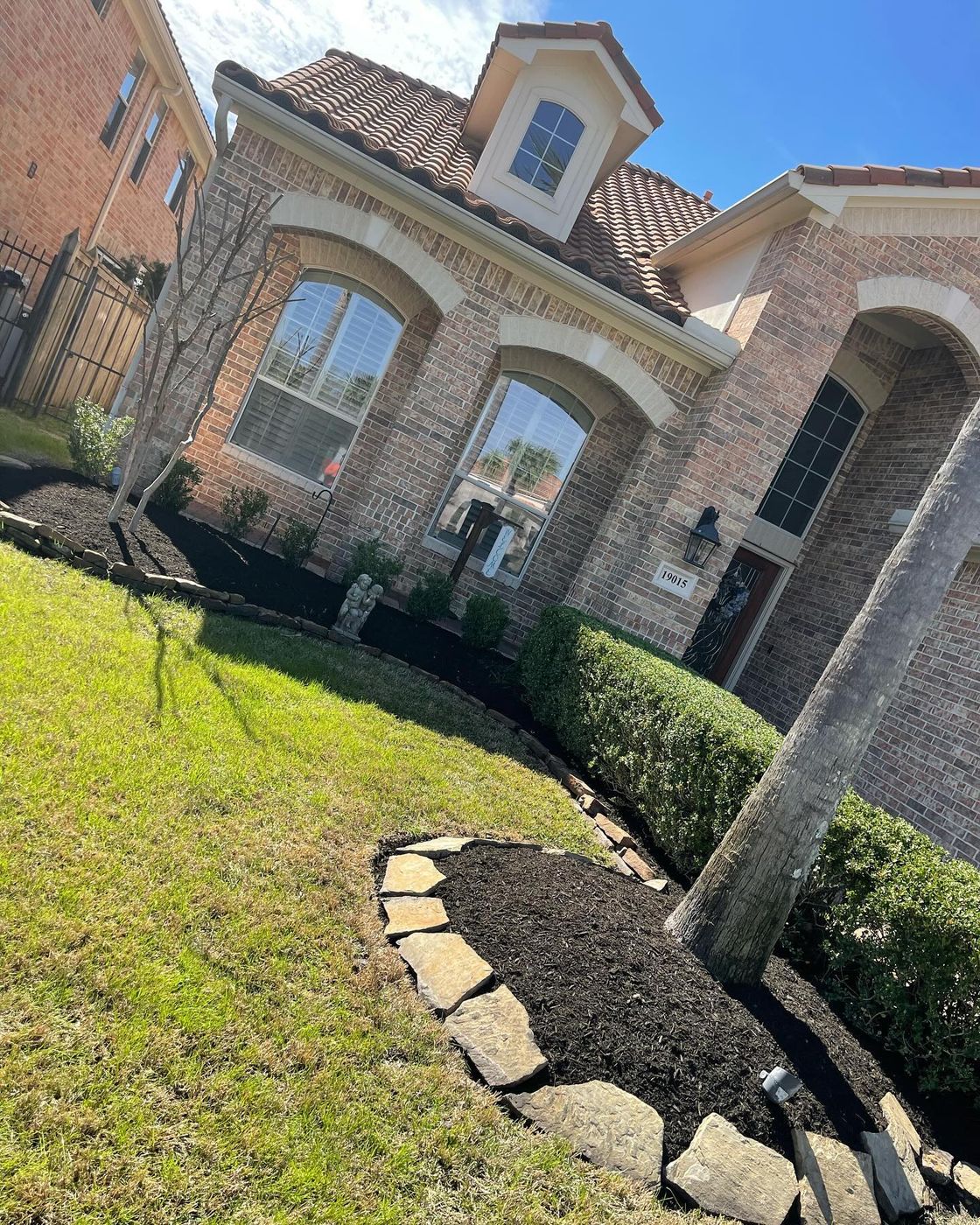
A low stone border holding a clipped shrub bed at the front of a brick house. This is bed edging, a border that holds a line. It is not a retaining wall.
Which wall is it?
A bed border is not a retaining wall
Retaining wall
Holds soil back. Needs a compacted base, drainage and a drain line.
Border wall
Holds a bed line and keeps mulch in. Low, on a level base, with a clean edge.
Not sure which one your yard needs? Tell us what the ground is doing and we will say.
Hardscaping in Houston, answered
What does hardscaping cost in Houston?
There is no flat rate. The price follows the size of the job, the material you choose, how deep the base has to go and how much water the ground has to shed. We look at the site first, then quote, so the number matches what is actually there.
Do I need a retaining wall or a border wall?
A retaining wall holds soil back at a slope or a change in grade, and it gets drainage behind the face. A border wall holds a bed line and keeps mulch in. If the ground behind it can slide or wash out, you want a retaining wall.
Does a wall need an engineer or a permit?
For taller walls, or anything holding a driveway, pool deck or structure, an engineered design and a permit are often the right call, and we tell you so plainly at the estimate. What applies depends on the height, the load behind the wall and where the property sits.
Which areas do you build in?
Houston first, then out through Cypress, Pasadena, Pearland, Alief, League City, The Woodlands, Sugar Land, Baytown, Missouri City, Katy and Jersey Village. If the property sits outside those, send the address with your request and we will tell you whether we can come out.
Tell us what the ground is doing
The address, the slope or the spot you want built, and where the rain goes today. We come out and look before we quote.